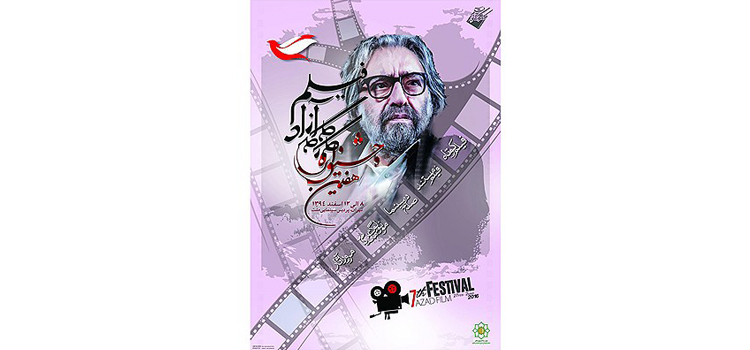
The closing ceremony of the seventh Kimiai Free Filmmaking Workshop Festival was held on the 12th of Esfand, with many prominent figures from the Iranian arts scene in attendance, and Masoud Kimiai, the festival’s director, shared some words of guidance with young aspiring filmmakers.
Hossein Heidaripour, the festival’s secretary, opened by recounting the history of the event and said: the seventh edition of the Free Film Workshop Festival — which began in 2006 entirely independently, thanks to the efforts of Masoud Kimiai — hosted 300 domestic and 140 international works, of which 97 films competed in the competition section. This festival has been held without a single rial of government funding, and we hope it will soon have a permanent secretariat so it can be held every year. Masoud Kimiai, director of the Free Film Workshop, then took the floor and addressed the students of the school, saying: the only thing I dream of, the only future I have left — and not much of it remains — is for the Free Film Workshop and its talented students to make good, socially engaged films. He continued: make socially engaged films. Don’t make comedies. There’s plenty of time for laughter. Whatever help is available, the Free Film Workshop will extend it to you as far as it can reach. The ceremony also included tributes to Farimah Farjaami and Behrouz Afkhami. It was announced that Farimah Farjaami was unable to attend due to poor health, and a plaque of appreciation was then presented to Behrouz Afkhami, who was honored on stage. After presenting Afkhami with the plaque — which he had written out in his own handwriting — Masoud Kimiai said of the filmmaker: I have a great deal of affection for Afkhami, because he is brave and bold, and more importantly, he does exactly what he wants to do.
Kimiai then added: I want to walk back something I said — I told you not to make comedies, but then I thought of Dariush Mehrjui’s films and realized that yes, a great comedy can be made. So go ahead and make comedies — just don’t make cheap, vulgar ones. After Kimiai’s remarks, Behrouz Afkhami received his plaque and said: this is the finest gift I have ever received. When I was a teenager watching Kimiai’s films, I never in my wildest dreams imagined that one day Masoud Kimiai would hold a tribute in my honor. Just as I never imagined I would collaborate with Nemat Haghighi and have him shoot a film for me — and yet, whatever we truly wish for, eventually finds its way to us. In another part of the ceremony, tributes were paid to Hamed Ebrahimpour, poet and cinema instructor, and Alireza Bahrami, poet and documentary filmmaker — both of whom have referenced and paid homage to Masoud Kimiai’s films throughout their work and careers — with Masoud Kimiai, Behrouz Afkhami, and Javad Tousi all present on stage. Naghmeh Danesh-Ashtiani and Mahdi Ahmadi received plaques as representatives of Honarmand newspaper and Mehr News Agency, respectively. Mostafa Zabarjad and Hadi Nasiri-Rahimi were recognized as two dedicated journalists who had closely followed and supported the festival. The winners across the various sections of this edition of the festival were then announced.
In the documentary section, the Best Technical Achievement award was presented to Emad Hosseini for the film Tehran Khaniabad 1366, from the Independent Short Film Support Base.
The Best Research award was presented to Seyyed Hamid Mirhosseini for Harakat dar Sokut (Movement in Silence) — Honorary Diploma — and to Seyyed Ali Sheidaei for Laleh Sho (Become a Tulip) — Statuette.
In the Best Direction category: Habib Bavi Sajed received the award for Lalaiye Jang (Lullaby of War).
In the Best Film category, Mohammad Sangouri was named the worthy recipient of the award for Baradaran-e Zamin (Brothers of the Earth). In the Peace Award category, the festival’s statuette and honorary diploma were presented to Salem Salavati for Badbadak-haye Bi Bad (Kites Without Wind). In the international section, the films Sled from Italy and Valley of the Whales from Iceland were recognized as worthy of distinction.
In the fiction section, the Technical Achievement award was presented to Soudabeh Kamrani for En’ekas-e Siah (Black Reflection) — Honorary Diploma — and to Amin Ashrafi for Mehrabad-e Jonoubi (South Mehrabad), from the Independent Short Film Support Base — Statuette.
The Best Screenplay award was presented to Hamidreza Bababeygi for “Jib-haye Barani-at ra Bigard” (Search Your Rainy Pockets), from the Independent Short Film Support Base.
The Best Actress award was presented to Kataneh Afsharnejad for Gahi Nisti (Sometimes You’re Not There) — Honorary Diploma — and to Zhila Shahi for her performance in “Bagh-e Bi Bargi” (The Leafless Garden), from the Independent Short Film Support Base — Statuette.
The Best Actor award was presented to Hamed Sheikhi for his performances in the two films Sarab (Mirage) and Farzandan-e E’dam (Children of Execution).
The Best Direction award in this section went to Reza Fahimi for Kudakan-e Abri (Cloudy Children) and Shahrzad Dadgar for 500 Mesqal Tala (Five Hundred Mithqals of Gold), from the Independent Short Film Support Base — both receiving Honorary Diplomas — and to Babak Ghaemi for “Jib-haye Barani-at ra Bigard” (Search Your Rainy Pockets), from the Independent Short Film Support Base — Statuette.
The Special Jury Prize was awarded to two films: Zistan-e Morgh-e Moqalled (The Life of a Mockingbird) and Man Qadimi Hastam (I Am Old-Fashioned).
The winners received their plaques and statuettes from Masoud Kimiai, Behrouz Afkhami, and Farzad Motamen.
At the close of the ceremony, it was also announced that several filmmakers — Babak Ghaemi, Shahrzad Dadgar, Adel Tabrizi, and Iran Entezari — will be supported with production equipment for the making of their next films, as a gesture of recognition and encouragement.